LLM Evaluation Frameworks
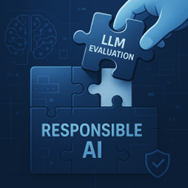
Large Language Model (LLM) evaluation frameworks are structured tools and methodologies designed to assess the performance, reliability, and safety of LLMs across a range of tasks. Each of these tools approaches LLM evaluation from a unique perspective—some emphasize automated scoring and metrics, others prioritize prompt experimentation, while some focus on monitoring models in production. As large language models (LLMs) become integral to products and decisions that affect millions, the question of responsible AI is no longer academic—it’s operational. But while fairness, explainability, robustness, and transparency are the pillars of responsible AI, implementing these ideals in real-world systems often feels nebulous. This is where LLM evaluation frameworks step in—not just as debugging or testing tools, but as the scaffolding to operationalize ethical principles in LLM development.
From Ideals to Infrastructure
Responsible AI demands measurable action. It’s no longer enough to state that a model “shouldn’t be biased” or “must behave safely.” We need ways to observe, measure, and correct behaviour. LLM evaluation frameworks are rapidly emerging as the instruments to make that possible.
Frameworks like Opik, Langfuse, and TruLens are bridging the gap between high-level AI ethics and low-level implementation. Opik, for instance, enables automated scoring for factual correctness—making it easier to flag when models hallucinate or veer into inappropriate territory.
Bias, Fairness, and Beyond
Let’s talk about bias. One of the biggest criticisms of LLMs is their tendency to reflect—and sometimes amplify—real-world prejudices. Traditional ML fairness techniques don’t always apply cleanly to LLMs due to their generative and contextual nature. However, evaluation tools such as TruLens and LangSmith are changing that by introducing custom feedback functions and bias-detection modules directly into the evaluation process.
These aren’t just retrospective audits. They are proactive, real-time monitors that assess model responses for sensitive content, stereotyping, or imbalanced behaviour. They empower developers to ask: Is this output fair? Is it consistent across demographic groups?
By making fairness detectable and actionable, LLM frameworks are turning ethics into engineering.
Explainability and Transparency in the Wild
Explainability often gets sidelined in LLMs due to the black-box nature of transformers. But evaluation frameworks introduce a different lens: traceability. Tools like Langfuse, Phoenix, and Opik log every step of the LLM’s chain-of-thought, allowing teams to visualize how an output was generated—from the prompt to retrieval calls and model completions.
This kind of transparency is not just good practice; it’s a governance requirement in many regulatory frameworks. When something goes wrong—say, a medical chatbot gives dangerously wrong advice—being able to reconstruct the interaction becomes essential.
“Transparency is the currency of trust in AI.” Evaluation platforms are minting that currency in real time.
Building Robustness through Testing
How do you make a language model robust? You test it—not just for functionality but for edge cases, injection attacks, and resilience to ambiguous prompts. Frameworks like Promptfoo and DeepEval excel in this space. They allow “red-teaming” scenarios, batch prompt testing, and regression suites that ensure prompts don’t quietly degrade over time.
In a Responsible AI context, robustness means the model behaves predictably—even under stress. A single unpredictable behaviour may be harmless; thousands at scale can become systemic risk. By enabling systematic, repeatable evaluation, LLM frameworks ensure that AI systems do not just work but work reliably.
Bringing Human Feedback into the Loop
Responsible AI isn’t just about models—it’s about people. Frameworks like Opik offer hybrid evaluation pipelines where automated scoring is paired with human annotations. This creates a virtuous cycle where human values help shape the metrics, and those metrics then guide future tuning and development.
This aligns perfectly with a human-centered approach to AI ethics. As datasets, models, and applications evolve, frameworks with human-in-the-loop feedback ensure that evaluation criteria remain aligned with societal norms and expectations.
The Road Ahead: From Testing to Trust
So, are LLM evaluation frameworks the backbone of Responsible AI?
In many ways, yes. They offer the tooling to make abstract ethics real. They monitor, measure, trace, and test—embedding responsibility into the software stack itself.
LLM frameworks are no longer just developer tools—they are ethical infrastructure. They help detect and reduce bias, enforce transparency, build robustness, and enhance explainability. Tools like Opik, Langfuse, and TruLens represent a new generation of AI engineering where responsibility is built-in, not bolted on.
Questions for Further Thought:
- Can we standardize metrics like “fairness” or “bias” across domains, or must every use case be uniquely evaluated?
- Should regulatory compliance (e.g., AI Act or NIST AI RMF) be integrated into LLM evaluation frameworks by default?
- As LLMs evolve, how can we ensure that evaluation frameworks stay ahead of emerging risks—like agentic behaviour or multimodal misinformation?
In the pursuit of Responsible AI, LLM evaluation frameworks are not just useful—they are indispensable.
 COSMICOUS